Tuesday, September 29, 2009

Truly Trivial: What events comprise a close encounter of the fifth kind?

Dr. J. Allen Hynek (left) and Dr. Jacques Vall...Image via Wikipedia
Hot on the heels of last week's Nerd Word -- Majestic 12 -- we return to the surprisingly timely topic of alien abduction. Most of the current upturn in alien interest is due to the new Milla Jovovich movie The Fourth Kind, which ostensibly profiles alien abductees using real (for Blair Witch Project values of real) interview footage. The film's title refers to the fourth type of so-called close encounter, wherein humans are abducted by the occupants of UFOs. Setting aside the plausibility of actual UFO abductions, have you ever wondered who it was that conjured up this enumerated spectrum of close encounters?

Look no further than one J. Allen Hynek, an astronomer and ufologist who had the distinction of both working for Project Bluebook -- the U.S. Air Force investigation into UFO phenomena -- and for publishing a moderately famous book on the subject, The UFO Experience: A Scientific Inquiry. Hynek is the founder of the Center for UFO Studies and, as much as such a thing is possible, is considered a reliable authority on unidentified flying object investigations. In the aformentioned UFO Experience, Hynek laid out three kinds of close encounters to categorize the various UFO reports that he had analyzed (and, most often, debunked) during his tenure as adviser to the Air Force and as a civilian investigator:
  1. Close encounter of the first kind, wherein a UFO is merely observed
  2. Close encounter of the second kind, wherein physical evidence of a UFO is recovered
  3. Close encounter of the third kind, wherein the occupants of a UFO are observed
Despite what Jovovich's PR folks might have you believe, there was no fourth kind of close encounter when Hynek published the scale in 1972. Nor did he explicitly add a fourth kind to the scale before his death in 1986. This was added later by other ufologists, with some significant contributions by Jacques Vallée, Hynek's frequent collaborator and perhaps the only other well known "respectable" UFO researcher. (Vallée was the real-life inspiration for the lead research scientist character, Lacombe, in Steven Spielberg's Close Encounter's of the Third Kind.)

For his part, Vallée did not explicitly endorse the alien abduction defintion of fourth kind of close encounter, but merely described them as "cases when witnesses experienced a transformation of their sense of reality." Vallée was equally circumspect as to the definition of a close encounter of the fifth kind, the most involved and potentially definitive UFO interaction of the revised close encounter scale.

So, what events comprise a close encounter of the fifth kind?

Thursday, September 24, 2009

Nerd Word of the Week: Majestic 12

Two extraterrestrial (E.T.) alien Martians dri...Image by loomingy1 via Flickr
Majestic 12 (n.) - One of several purported code names for an ostensible ongoing conspiracy between scientists, military leaders, and government officials to investigate and/or obscure evidence of UFOs. It is the assumed precursor to more well known (and substantiated) government UFO efforts such as Project Sign, Project Grudge and Project Blue Book. Also known as Majic 12Majestic TrustM12MJ 12MJ XII or Majority 12, this group holds a prominent place both in the mythology of ufologists and UFO conspiracy theorists, as well as the science fictional works which play off UFO cover-up themes. The X-Files is perhaps the most famous example of using Majestic 12 as a recurring plot device, though the less successful series Dark Skies was more explicit in its use of this supposed organization.

I bring it up because: On this date 62 years ago -- Sept. 24, 1947 -- President Harry Truman supposedly commissioned "Operation Majestic Twelve." The executive order has been serially debunked, but it nonetheless serves as the lynchpin around which much ufology and conspiracy lore revolves. Moreover, UFOs and their associated fringe theories are coming back into style if the Nov. 6-opening Milla Jovovich alien abduction movie The Fourth Kind is any indication. Debuting the same day is the George Clooney comedy The Men Who Stare at Goats, which is based on another oft-cited conspiracy theory -- the supposedly true story of the U.S. government's attempts to create a squad of psychic soldiers. Following just a week after that is 2012, the Roland Emmerich disaster flick (that's both a genre and a prediction for this movie) based on yet another fringe science/conspiracy theorist trope -- that the world will end when the Mayan Long Count calendar "runs out" in the year 2012. Face it, when there's a network TV series called Fringe that's pulling decent ratings, the fringe itself has got have a little mainstream cred. Just ask the new First Lady of Japan, who has visited Venus on a UFO. Personally, I blame the secret masters of Majic 12. That, or Coast to Coast AM. Same difference, really.

Reblog this post [with Zemanta]

Tuesday, September 22, 2009

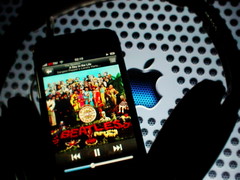
Truly Trivial: What secret F-U to the Beatles is hidden in the Mac OS?

wallpaper - beatles & apple
It's part of the accepted wisdom of the technology community that Apple Computer cofounder Steve Jobs is a paranoid, narcissistic jerk who has channeled his character flaws into both a cult of personality and a world-changing consumer-tech empire. I mean, you've got to be something of a high-profile jackass for The Simpsons to devote and entire episode B-plot to punking you out, and since company culture often reflects the personality of its executive leadership, it's little wonder that Apple has a long and glorious history of getting sued by unlikely people. (Carl Sagan? Seriously?)

Still, it takes a special man and a special company to wage a three-decades-long trademark war with The Beatles. The core of this dispute (pun intended) is that the holding company for most of The Beatles' intellectual property is Apple Corps, which felt that Jobs' and Steve Wozniak's fledgling little tech concern was treading on their trademark turf. This dispute was settled in 1981 when Apple Computer paid Apple Corps $80,000 and promised not to enter the music business. So long as there was a clear separation between which company made tech and which company made (or, rather, licensed) music, everything was cool.

Then, in 1986, Apple started integrating MIDI synthesizer chips into their computers, a trend that culminated in the Apple IIGS line of desktops. To Apple Corps thinking, this was a breach of the settlement, so the Beatles IP-holder sued Apple Computer again. And won. And killed the IIGS line, along with any direct hardware integration of synthesizer or music-mixing tech into Apple computers.

Now, as they say, it was on.

Apple resented the Beatles for nixing its foray into sound tech, and Apple Corps was watching Apple Computer like a hawk for any sign that Steve Jobs' company was treading anywhere near music industry territory. It got so bad inside Apple Computer that the company's legal department had to sign off on any system sounds that may or may not be interpreted as "excessively musical."

Thus it came to be that in 1991 former Apple sound designer Jim Reekes created a little file that has been in every Mac OS since System 7 -- one intended in part as a subtle, secret kiss-off to Apple Corps and their legal representatives for all the inconvenience their litigious oversight caused Apple Computer developers.

So, what secret F-U to the Beatles (or, at least, their lawyers) has been hidden in the Mac OS for almost 20 years?

Thursday, September 17, 2009

Nerd Word of the Week: Noosphere

Linux Kernel Map
Noosphere (n.) - Intellectual term for the sphere of human thought, and/or a medium of exchange for all human ideas and knowledge. Sometimes used as a metaphorical synonym for cyberspace, the Internet. The related terms Noocene and noocracy refer to the era when humans became self-aware and began improving themselves though idea sharing, and a system of government that directly acknowledges and harnesses this awareness, respectively.
The noosphere is a recurring plot device in science fiction, perhaps most notably in The Gone-Away World by Nick Harkaway, which saw noospheric weapons ravaging human civilization by permantly erasing ideas, and in the anime/manga series Neon Genesis Evangelion, in which several characters sought to make the noosphere a tangible reality.
I bring it up because: Eighteen years ago today, the first version of Linux kernel was released to the Internet. This led to a revolution in software development and the publication of two seminal essays by Eric S. Raymond: "The Cathedral and the Bazaar" and "Homesteading the Noosphere." The former deals with top-down versus grassroots software engineering and commerce. The latter discusses the possibility and preconcpetions of actually owning and profiting from ideas in an era when said ideas can be massively, instantly, and freely exchanged via the Internet. The noosphere is thus an overlap concept between science and science fiction, wherein this collective intelligence of humanity is simultaneously a philosophical construct, a sociological phenomenon, and economic force, and a buzzword-compliant synonym for the Web. Plus, if you know how to spell and pronounce noosphere, you've got instant nerd-cred.


Reblog this post [with Zemanta]

Wednesday, September 16, 2009

Goodbye Written Weird, hello Jay Garmon dot Net

prepare to dieImage by 1541 via Flickr
Last night, my colleague Jason Falls gave a presentation on the importance of maintaining your personal brand online. Among his key points of advice was owning your own domain name. Unfortunately, most of the valuable versions of my name as a domain have been on backorder for months or years (stupid GoDaddy auto-renew).

Rather serendipitously, JayGarmon.net finally came through this morning. As such, the Written Weird is no more -- or won't be by this weekend, when the DNS propagation is complete. (For the record, JayGarmon.com is owned by a State Farm agent in Russell Springs, KY -- no relation -- and I don't expect I'll ever get that URL.) Going forward, this site will be known as Jay Garmon [dot] Net. Yes, I totally cribbed the title styling from Wil Wheaton. The change is largely cosmetic, intended mostly for SEO and branding purposes. Blogger will auto-redirect all the old link equity, and since Google owns Blogger, I'm told that little to any PageRank damage will be incurred. We'll see.

In any case, the content of this site will remain the same. Moreover, the fact that my URL came through just before I relaunched my personal trivia column is a tasty piece of happy. With any luck, I'll have the new DNS situation squared before I appear on TechTalk radio this weekend. Sometimes, things just go right.


Reblog this post [with Zemanta]